
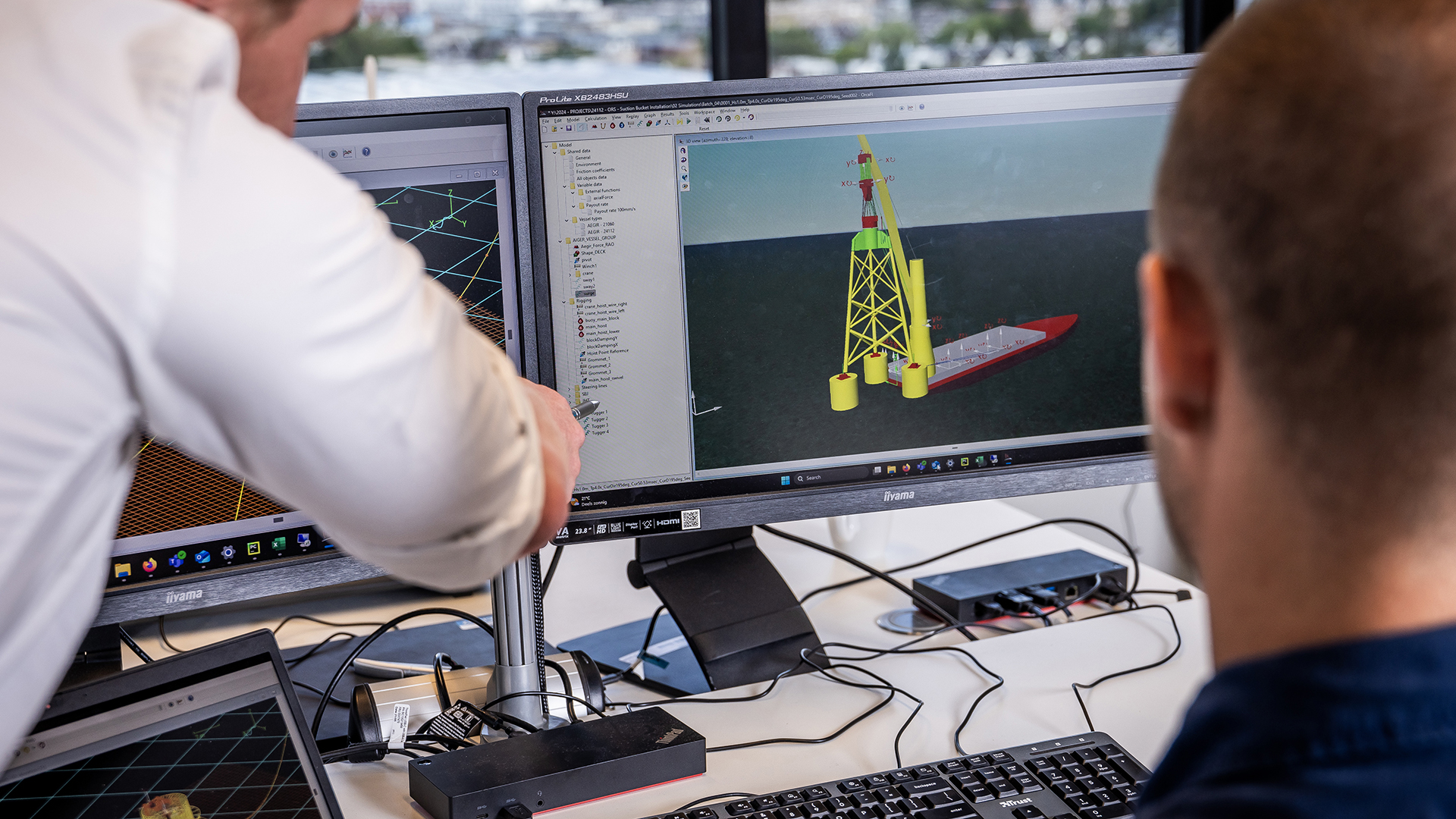


For complex fluid dynamics, we can use CFD to fulfill the needs of our clients. Depending on the project scale and wishes, we can conduct full CFD studies or simply define a subscope to support in areas where typical approaches become too simplistic and invalid.
We realize that CFD is not only about showing diagrams with fancy colors, albeit colorful, we strive to capture the relevant physics ruling the fluid behavior and therefore, on our portfolio we have compiled a list of different topics each benchmarked with experimental data or validated studies. For instance:
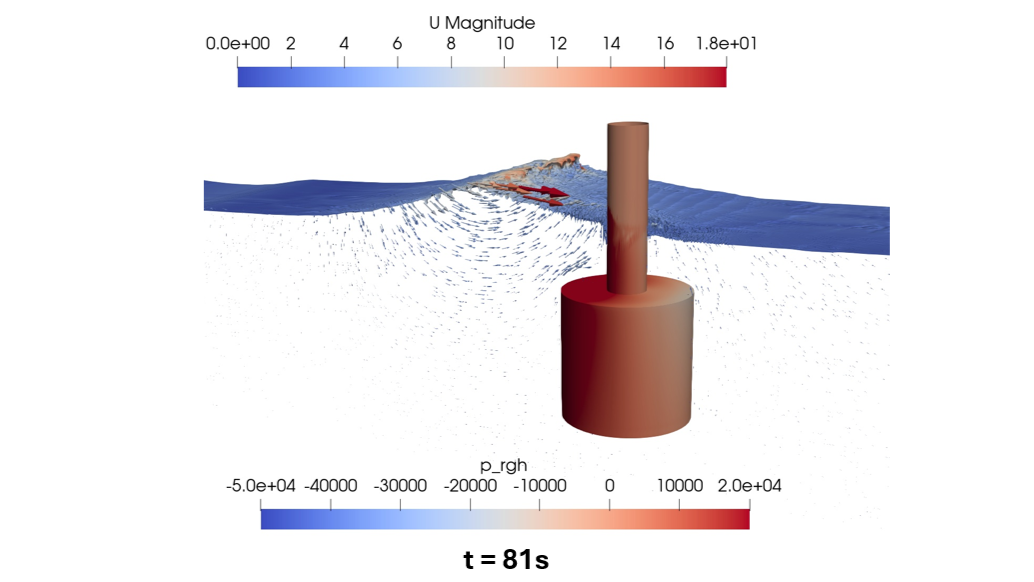
Heaving suction bucket in the splash zone: During the installation of jackets with suction buckets, the typical methods using diffraction software can be less accurate since the radiation problem does not consider the transient behaviour of the bucket, especially close to the free surface as the entrapped air creates a cushioning effecr. This can lead to less accurate etimates of natural modes and impact DAF values , operability and/or workability figures, important for the HLV contractor.
Ship roll damping: For the assessment of vessel motions, it is typical to compute the RAOs with diffraction software which are known to underpredict viscous damping effects. Obviously, since it is based on an inviscid formulation. To compensate for this problem, CFD can be used to compute the missing roll damping sources and thus update the hydrodynamic properties of the RAO. This will lead to a much realistic roll amplitude and potentially of the coupled terms as well such as surge amplitude.
Drag study: We believe this is one of the most classic problems within our industry. Estimating the drag coefficient on offshore structures is often reduced to simple geometries such as squares, cylinders, spheres, etc. While this is pragmatic and conservative, there are instances where such an approach can lead to overengineered systems with an unnecessary cost due to overpredicted loads. In this case, CFD can be used to get a more accurate estimate.
Breaking waves, runup and slamming on complex object: Effects of steep waves on offshore structures and impact loads are notoriously complex and are usually highly simplified with conservative recommended practice an guidance derived from empirical work. CFD helps to bridge the gap between lower-fidelity equations and models and limited experimental data.
If curious on how CFD can be determinant to your project or to discover the full extend of our portfolio feel free to reach out to our team. Part of our CFD portfolio is built with a streamline approach in mind so certain aspects have been parametrized to deliver results fast. We are also available for non-standard studies.
1. Lender’s engineering
As independent lenders’ engineers we provide clear, impartial technical assessments that bridge gaps between stakeholders and help resolve insurance or contractual disputes. We verify whether designs, tests and operations align with industry practices and whether the documented approach truly reflects the complexity encountered in the field. Our reports are concise, evidence-based and focused on material risks and mitigations — giving financiers and insurers the technical certainty they need to support decisions, close financing loops and reduce downstream claims exposure.
2. Project engineering — 3rd‑party review
Our project engineering reviews draw on broad experience across project documentation, execution and handover, supported by a long list of reference projects. We rapidly assess design packages, QA/QC records and technical interfaces to identify gaps, non-conformities and optimisation opportunities. With flexible, on-demand resourcing we integrate quickly into project timelines to de-risk schedules and budgets. Clients benefit from pragmatic recommendations that improve constructability, reduce rework and strengthen contractual clarity — accelerating delivery while protecting project value.
3. R&D — 3rd‑party review
For R&D programmes we identify which physical phenomena matter at each development stage and validate whether testing, modelling and assumptions are fit for purpose. We specialise in modeling novel systems and translating high complexity into actionable design criteria and go/no-go decisions. Our engineers are comfortable with high uncertainty and new technologies, focusing on the underlying physics to separate critical risks from secondary effects. This approach helps clients prioritise experiments, streamline development paths and increase confidence in innovation outcomes.

We have developed a mid-level simulation environment to include human factor into a real-time simulation environment. This may aid training of your team of validating T&I procedures.